Published January 26, 2026
Take the question of what happens to the value of the stock market when an investor sells bonds and buys stocks. The answer may seem obvious, the value of the stock market goes up. However, in an efficient market, this isn’t the case. With information available instantaneously, a near unlimited ability to process it, and money on the line, prices are kept in line with fundamental value. Beyond small and short-lived mispricings, new flows aren’t enough to counter this. Only information that reveals something new about fundamental value, and warrants a greater willingness to buy or sell, can impact prices. Market prices need a reason to be swayed; demand only exists at prices below or equal to fundamental value and collapses above it. Supply is equally particular. Even if uninformed investors were willing to pay prices well above fundamental value, existing shareholders would gladly supply a practically infinite number of shares to capitalize on high prices, quickly extinguishing any price impact. The end result is a capital allocating machine driven by fundamentals and information. The “informed” view of the future that emerges from this machine is why markets are considered a leading indicator, and when statements are made such as “equity markets show strong expectations of nominal growth,” it is because of the continued functioning of this process that they can be.
Financial economists have long defended this view, while dismissing the practitioner’s view that prices go up when there are more buyers than sellers. However, Gabaix and Koijen provide a vigorous and empirical foundation vindicating the practitioner. From observing flow of funds data Gabaix and Koijen demonstrate that the stock market is extremely sensitive to flows, with a $1 investment in the stock market increasing the aggregate value of the market by approximately $5. A remarkably significant price impact, which according to the traditional view should be arbitraged away and certainly not long lasting. They called this the “inelastic market hypothesis.”
To identify the impact of selling $1 worth of bonds to buy $1 worth of stocks Gabaix and Koijen couldn’t just look at flows and the change in price that followed, because often flows and prices move in response to the same news. For example, in light of positive economic news, investors may buy more stocks and prices may also rise, but that doesn’t mean the buying caused prices to rise. To account for this, Gabaix and Koijen looked at trading patterns across institutions and used statistical techniques to remove instances of buying or selling that looked like a shared response to common conditions. With only buying or selling attributable to institution specific factors and unrelated to changing fundamentals, they could then measure how much prices rose when demand did. Most financial economists would have predicted a very small impact, around one cent for every dollar invested. However, for individual stocks the impact of flows on price is roughly equal to the size of the investment, and for the aggregate stock market, Gabaix and Koijen found the impact is five times the size of the investment. Put differently, a flow equal to 1% of the value of equities pushes the value of the equity market up 5%. For robustness, Gabaix and Koijen performed the same analysis on 13F filings producing an estimate of price impact equally significant and consistent with their estimate derived from the flow of funds analysis.
This five-fold multiplier implies the aggregate stock market is surprisingly inelastic. To explain this inelasticity, Gabaix and Koijen point to the allocation of capital to strategies with rigid mandates, such as maintaining a fixed ratio of equities to bonds or passive buy-and-hold strategies. While demand should respond to the equity premium (the expected return of stocks over bonds), for a fund with a strict mandate to invest exclusively in equities there is no price at which it sells stocks for bonds. Passive investors are similarly insensitive to expected returns. They do not sell when prices rise or buy when prices fall; they simply hold. Additionally, households have been shown to maintain a high exposure to equities (around 80%) with little variation over time and economic conditions. The stability of this allocation does suggest there is a price at which investors start to sell; otherwise household equity exposure would explode higher with rising equity markets. However, in contrast to a rational model where investors would nimbly change their equity allocation in response to a shifting equity premium from say 75% to 50%, they instead sell just enough to maintain their same ~80% exposure, and even then the price still settles at an inflated level. In this context, the five-fold multiplier can be understood as not only the price impact, but also the distance the price needs to travel to generate this selling and absorb new demand. The combined effect is a market structure where demand shocks (flows) are not absorbed but amplified, and produce long lasting shifts in price.
The amplification of demand shocks is not merely a surface level phenomenon, it is observable in the daily mechanics of the order book. On the heels of Gabaix and Koijen’s paper, Jean-Philippe Bouchaud – the physicist turned founder of one of Europe’s largest hedge funds – published a paper corroborating Gabaix and Koijen’s findings, as well as providing the mechanical foundation necessary for understanding the macro-level findings. However, Bouchaud introduces a nuance: while Gabaix and Koijen observe a linear relationship over quarters, the daily microstructure reveals an initially concave relationship. Across markets (including equities, futures, options, and FX) and trading epochs (pre-2005 when liquidity was mostly provided by market-makers and post-2005 when high-frequency trading began to dominate market-making), a consistent relationship between the size of an order and its impact on price has been documented. The price impact isn't linear: doubling the order size doesn't double the price impact. Instead, the price impact scales with the square root of the order size: doubling the order size only increases the price impact by about 40%. And interestingly, the price impact does not decrease as market cap increases. Instead, the ability to buy or sell without meaningfully affecting price is a function of volatility and the fraction of the market cap traded (volume), making the price impact much bigger than it would have been had it been a function of market cap alone.
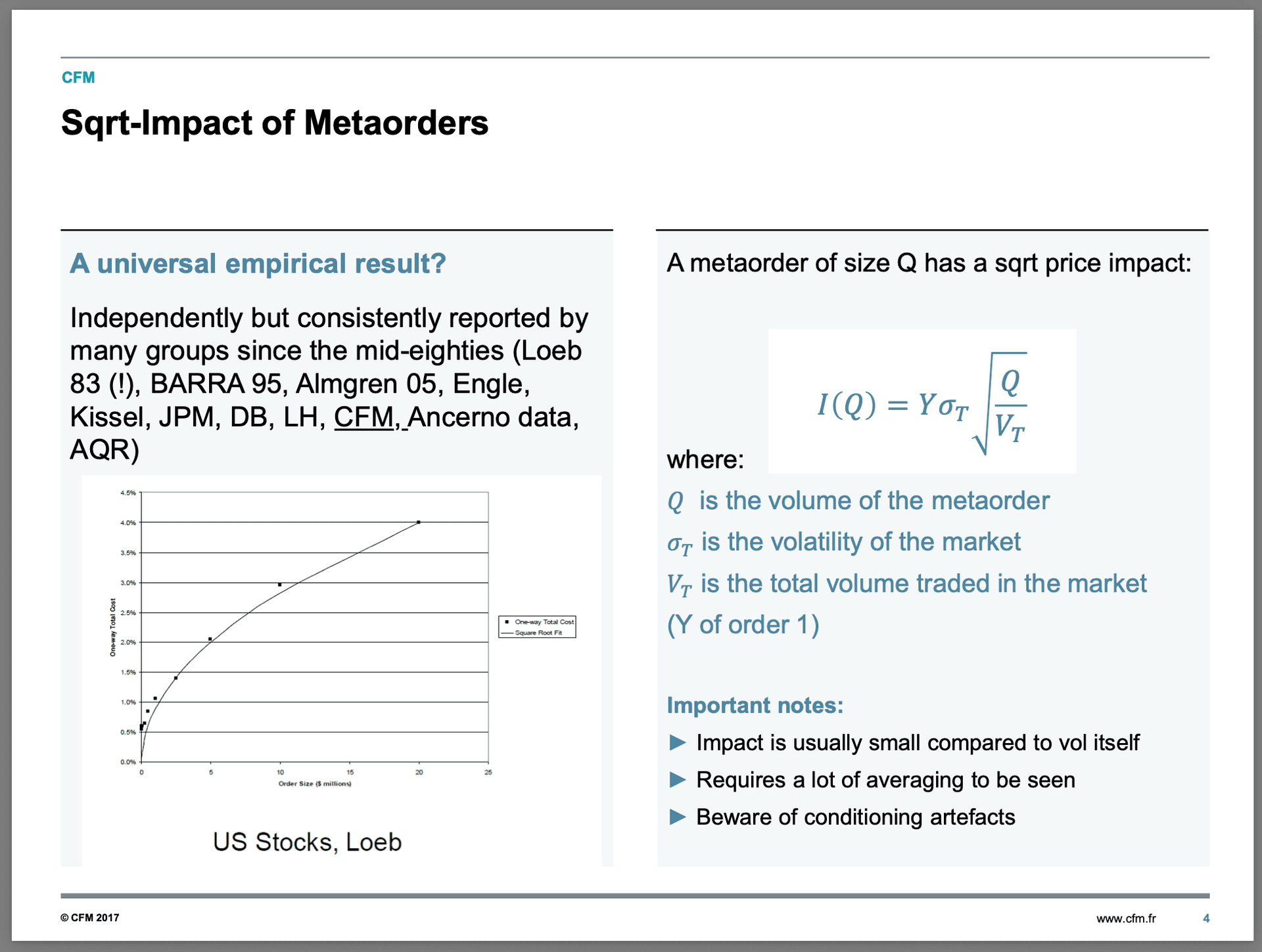
The elements of the formula are intuitive. Increased volatility leads to greater price impact because when prices are more likely to fluctuate, liquidity providers are prone to demand higher compensation for this risk, widening their spreads or exiting the market altogether. This reduces liquidity close to the current price and thins the order book, allowing an order to move the price further than it would otherwise. Increased trading volume represents greater market depth; as more shares trade, the deeper the order book and the faster it replenishes, reducing potential price impact. The inverse relationship between volume and price impact can be seen particularly clearly in the case of low-float stocks and their characteristically more dramatic price movements. To understand why the price impact is concave (scaling with the square root of size) rather than linear, one must look at what Bouchaud calls the Latent Liquidity Theory. The theory suggests that what is visible in the order book is only a portion of the market's true liquidity. Each investor has a price (“reservation price”) updated based on time, incoming news, and needs, at which they are willing to buy or sell, and the majority of liquidity actually exists as these latent intentions to trade. When a large order enters the market it consumes the available liquidity, the price then has to move higher for latent liquidity to come out of the woodwork, and as the price moves higher the more people there are that are willing to sell, so the price doesn’t have to move as far to find the next few shares as it did the first few. As a result, the second half of an order impacts the price much less than the first half, producing the concave shape. Over longer horizons, these concave daily impacts accumulate, and repeated order flow sums to produce the linear relationship Gabaix and Koijen observe at the quarterly level.
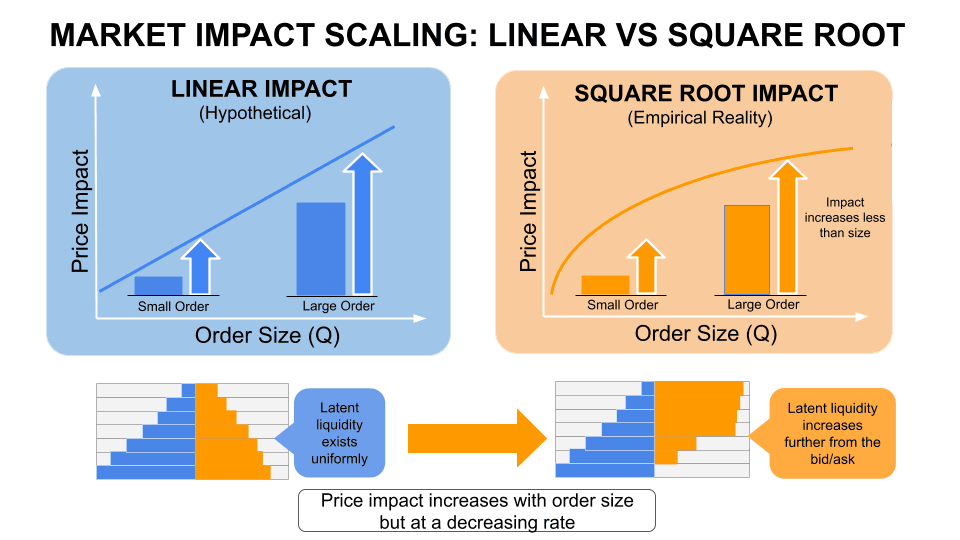
The effect of passive strategies identified by Gabaix and Koijen can be seen mechanically in Bouchaud’s work as a lack of latent liquidity. For the passive investor, value isn’t a consideration and attempts at timing the market are intentionally discarded. They trade less frequently and decisions to sell are effectively determined by their needs and stage of life, so as prices move higher, selling never comes into consideration. Institutions constrained by mandate are similarly removed from the “latent order book” of potential sellers. With fewer latent orders near the current price, rising prices are not only met with less resistance from selling pressure, but also have to travel further to induce the same quantity of selling. In different terms, the behavior of mandate-constrained funds and buy-and-hold investors lowers aggregate volume, a key contributor to increased price impact. This constraint is surprisingly acute in the largest segment of the market. While, given their size, one might expect large-cap stocks to be more elastic, Haddad et al. find that there is actually a negative relationship between a stock’s market cap and its elasticity.
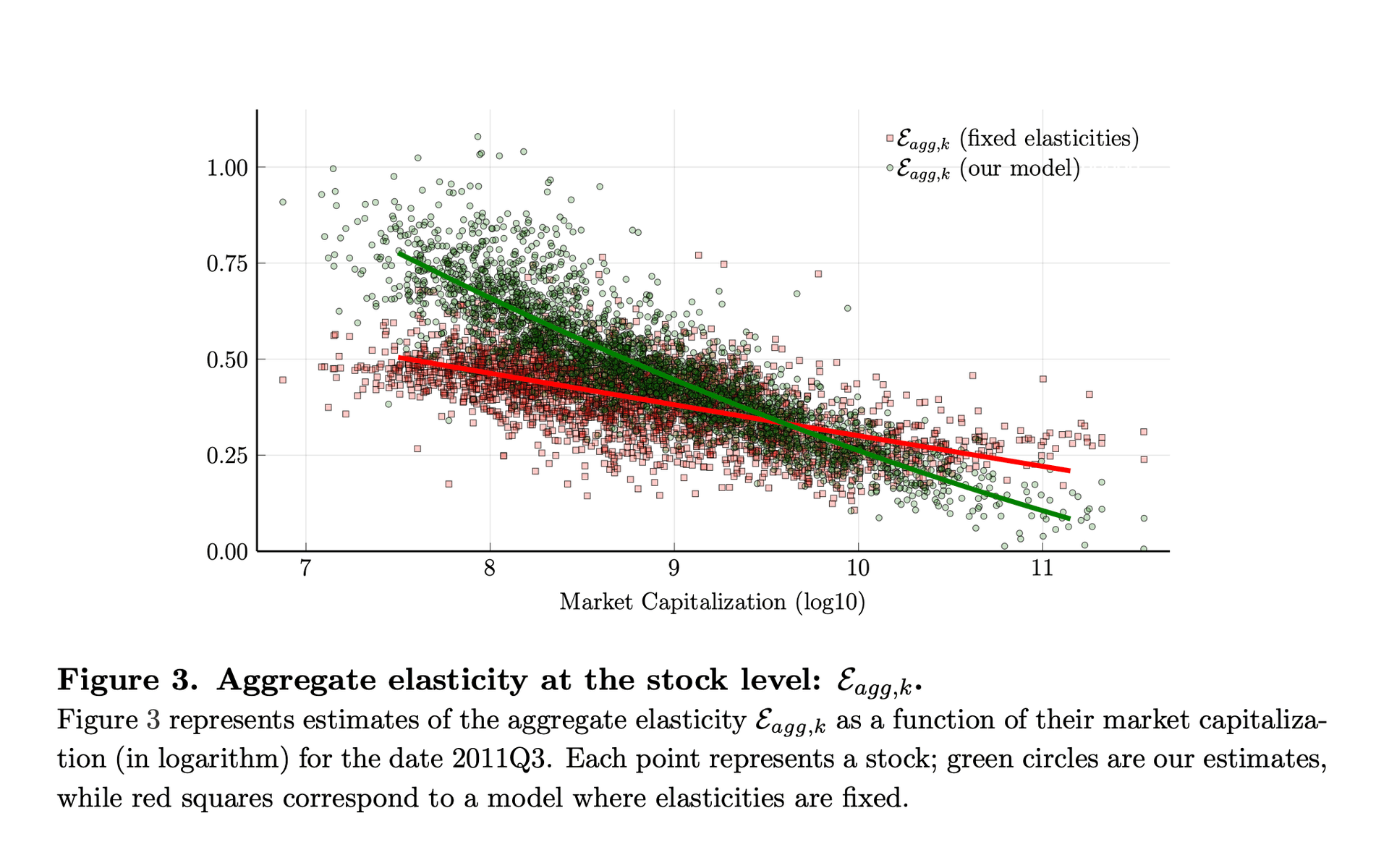
The tendency for large-caps to be more inelastic arises from their significant weight in the index and the fact that most institutional portfolios either track the index or are benchmarked against it. For portfolios tracking the index, the largest stocks are must-own names. For portfolios benchmarked against the index, omitting these names introduces “tracking error” and the possibility of underperforming the benchmark. In both cases, large-cap stocks obtain an almost “essential” status, as investors become "reluctant" to trade these positions aggressively, aware that to do so would disproportionately affect their portfolio. Unexpectedly, Haddad observes in 13F filings that there is much less trading activity among larger positions. Specifically, the top 50% of portfolio positions (by weight) account for only 9% of trading activity. The same investor behaves significantly more inelastically towards their large-cap holdings than they do their small-cap holdings. This selective behavior reduces “latent liquidity” and suppresses volume relative to market cap, creating the low-liquidity conditions required to generate greater price impact and making the largest companies especially vulnerable to flow-driven price spirals.
Crucially, the permanence of the price shift relies on how the market processes this new price level. Bouchaud notes that for the price impact to be temporary, investors must have some memory of the old price and believe the new price is wrong, ultimately bidding it down. However, because fundamental value is only vaguely known and market price itself is considered to reflect the view of well-informed market participants, some investors' estimation of value may realign around the new price. The buy-and-hold strategies and mandate-constrained investors identified by Gabaix and Koijen exist within this category. Passive buy-and-hold investors make no attempt at estimating fundamental value or timing the market but instead accept the new price level immediately. Investment strategies with rigid mandates, such as target-date funds, do not anchor to old prices either, but trade to maintain their mandated ratios behaving as if they have effectively revised their estimation of value to be in line with the new price. This lack of anchoring informs the price impact observed by Gabaix and Koijen. The longer investors believe in their original estimation of value and provide liquidity at that price, the more elastic the market and the lower the price impact. But once investors revise their estimation upwards with price, the would-be temporary impact only partially decays, leaving the permanent impact Gabaix and Koijen observed.
A real-world example of flows acting as the primary determinant of price is presented in the paper Ponzi Funds by van der Beck, Bouchaud, and Villamaina. With a large, anonymized thematic ETF as a case study, the authors compared the actual cumulative return of the ETF to the cumulative return derived from the square-root law using the ETF’s daily flows and the volatility and volume of its holdings. The cumulative price impact tracks the cumulative return almost perfectly, demonstrating that flows are not merely disturbing prices temporarily, but in an inelastic market driving prices.
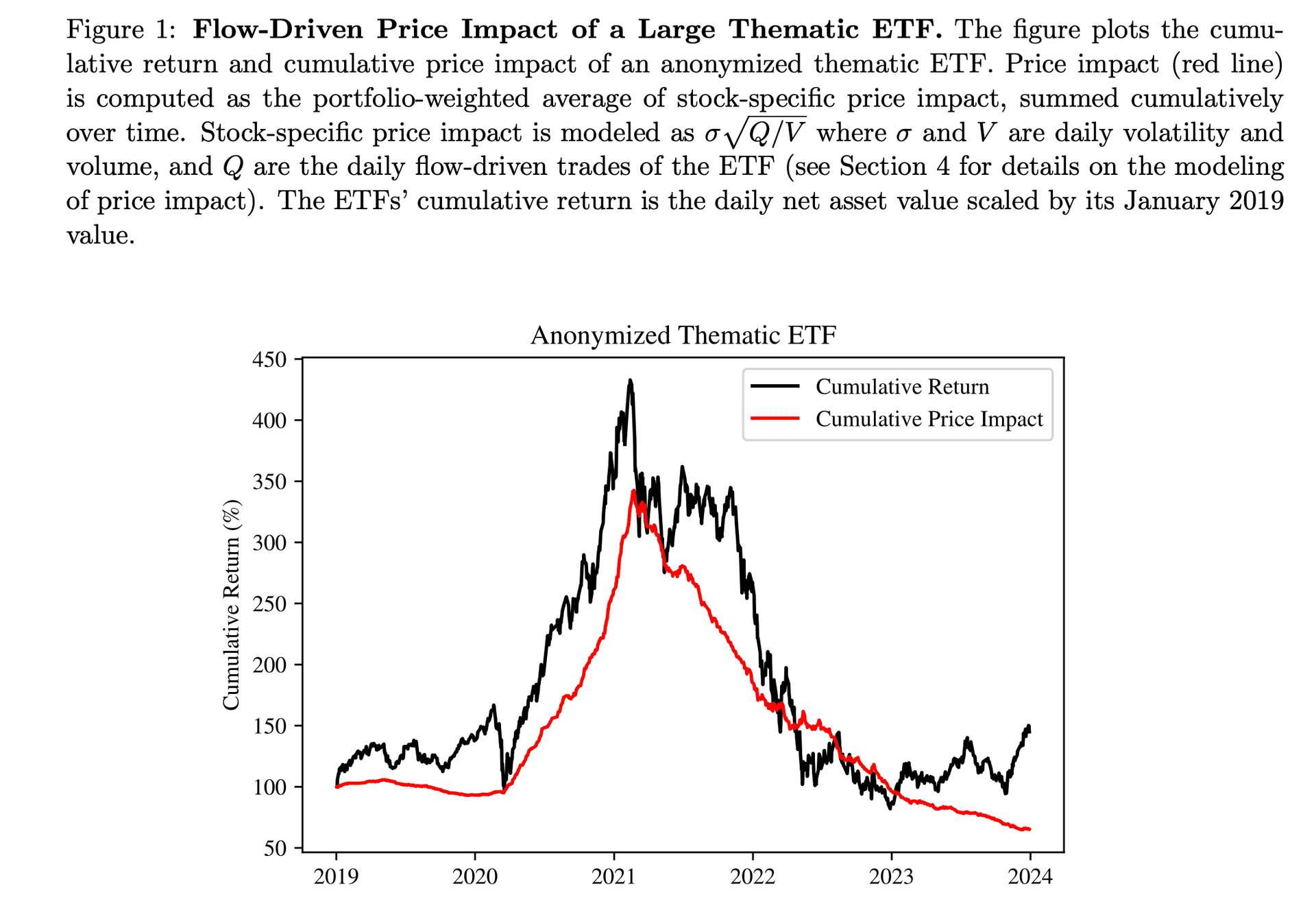
Interestingly, based on daily inflows, investors seem to show no sign of recognizing the price spike as baseless and selling (which would revert the price), instead they seem to do the opposite. By subtracting the cumulative price impact from the fund’s actual returns, the authors decomposed the fund’s returns into the portion of the returns generated purely by its own trading activity (the “self-inflated returns”) and the residual component representing returns driven by news, risk factors or genuine managerial skill (the “fundamental returns”). Comparing these decomposed returns against flows, the authors found that investors don’t differentiate between the two: they chase “self-inflated returns” with the same intensity as “fundamental returns.” Despite no new information warranting a higher valuation, investors accepted the new price level, serving as a real-world example of the theoretical inelastic market hypothesis mechanism, through which inflows can create bull markets and high prices persist so long as flows don’t reverse.
Instead of shoehorning seemingly random price movements into back-fit fundamental-narratives, the mystery of price movement becomes a more tractable problem of understanding flows. Certain aspects of recent market history begin to make more sense, and if the inelastic market hypothesis is correct, it raises consequences worth taking seriously for corporate finance, public policy, and market stability.
Textbook models fail when the relationship between equities and the risk-free rate breaks down. As the last couple of years have demonstrated, markets can continue making all-time highs at the same time rates are the highest they’ve been in recent history. Markets not only experience more extreme changes in price in response to the same volume of flows, but because flows are the primary determinant of price in an inelastic market, markets can behave in ways inconsistent with what a traditional asset pricing model would suggest. Perhaps due to mandates or passive strategies, bonds can remain cheap for longer if equities show little response to a changing equity premium. Equities can tip more easily into under or overvalued territory, bull markets can be the result of an influx of capital, and understanding flows can become more useful for predicting price action than understanding fundamentals and uncovering new information.
Buybacks are more accretive than dividends. In a world where the Modigliani-Miller theorem holds true, the choice to distribute cash via dividend or buyback is equivalent because the outcome for shareholders is identical, but in an inelastic market, buybacks can drive share prices higher making them more accretive than dividends.
The cost of equity can be artificially low. In an inelastic market, through index inclusion or strong institutional accumulation companies can find themselves benefitting from an artificially low cost of equity. The stigma around equity issuance then becomes outdated; companies should be more willing to fund projects with equity. In M&A, the beneficiaries of these circumstances have an advantage over buyers who must pay cash; consolidation becomes cheaper. The calculus around share-based compensation also looks different. Even though share-based compensation is a real economic expense via dilution and the drag on earnings per share, the dilution may never fully integrate into the share price when demand is persistent enough for the corporate treasury to effectively transact directly with the passive bid to subsidize compensation expenses.
The role of equity capital market desks expands. In an inelastic world where index inclusion provides a persistent financing advantage, actively managing index inclusion eligibility becomes another service investment banks can offer. Perhaps they already are. There does seem to be some awareness of this phenomenon at the corporate level. In a since deleted tweet, a Palantir board member said “We are moving @PalantirTech to the Nasdaq because it will force billions in ETF buying…” a likely allusion to Palantir becoming eligible for the Nasdaq-100 Index. Walmart is also moving from the NYSE to Nasdaq for seemingly similar reasons.
The inverse relationship between elasticity and market cap explains increased concentration. Because large market cap stocks tend to be more inelastic, incremental flows have a disproportionate impact on their share price, driving market caps higher and creating the level of concentration we see today. As of January 2026 the top five companies in the S&P 500 accounted for ~30% of the index’s total value, and the top 10 accounted for almost 40%. This may lend credibility to being overweight momentum strategies which are neither procyclical nor countercyclical but essentially “flow-informed.”
Rising wealth inequality may be partially mechanical in origin. In an inelastic market, rising wealth inequality may be a portfolio phenomenon where flows mechanically boost asset prices benefitting existing shareholders. It is worth noting that wealth inequality has increased more quickly in the U.S. than it has in Europe with the difference in part being linked to the significant increase in the value of the U.S. stock market, which is particularly interesting considering the U.S. has a 401k contribution system and Europe does not.
Price Impact Calculator
Sources and Further Reading
This essay was meant to be a review of the core inelastic market hypothesis literature listed below. For further reading and insights into the implications of passive and inelastic markets I strongly suggest Mike Green's newsletter. I cannot stress how good it is and could never do it justice. Additional resources are listed below.
Sources
In Search of the Origins of Financial Fluctuations: The Inelastic Markets Hypothesis
Xavier Gabaix, Ralph Koijen
The Inelastic Market Hypothesis: A Microstructural Interpretation
Jean-Philippe Bouchaud
Ponzi Funds
Philippe van der Beck, Jean-Philippe Bouchaud, Dario Villamaina
How Competitive is the Stock Market? Theory, Evidence from Portfolios, and Implications for the Rise of Passive Investing
Valentin Haddad, Paul Huebner, Erik Loualiche
Market Impact A (Short) Review
Jean-Philippe Bouchaud, Z. Eisler, I. Mastromatteo, B. Toth, M. Benzaquen, J. Bonart, F. Bucci, J. Donier, M. Gould